

Martha Coultas Ibbetson Gray (L) and Elizabeth Coultas Gray Leiper (R) (images enhanced)
Meet two revolutionary moms. Martha Ibbetson Gray brought aid and comfort to a prison full of suffering soldiers—and she brought her teenage daughter along to help.
Martha Coultas Ibbetson Gray did not set out to become a quiet legend. Yet by the time the American Revolution had run its course, her name was not only featured in family stories, but also in public record—earned through courage and service.
Born in London, daughter of Robert Ibbetson and Margaret Coultas, Martha apprenticed with an apothecary surgeon while still a teenager, learning to diagnose illness, prepare medicines, and perform the practical work of healing. It was an unusual path for a young woman, but one that would later prove indispensable.
Martha grew up in a Quaker household—a faith that valued discipline, humility, and devotion. It was Pennsylvania’s promise of religious freedom that drew them across the Atlantic. The Ibbetsons set sail in 1748, but their attempt at emigration nearly ended in tragedy when they were shipwrecked within sight of the Cliffs of Dover. Her father, considering himself warned by God, abandoned the idea. Two years later, he tried again—and this time, he and his family reached Philadelphia.
Within a year of her arrival, Martha married George Gray, a prominent landowner and ardent supporter of the Patriot cause. His family’s ferry across the Schuylkill River would later give its name to a neighborhood—Gray’s Ferry.
George’s political commitment ran deep. A birthright Quaker, George was read out of meeting for his support of the war. He aligned himself firmly with the cause of independence, serving in the Colonial Assembly, the Committee of Safety, the Board of War, and the Constitutional Convention.
Martha’s convictions matched his. When the British occupied Philadelphia in September of 1777, the city became a place of scarcity, and none suffered more than the American prisoners crammed into Walnut Street jail. Under abysmal conditions, nearly 900 men were held there, not as prisoners of war, but as traitors. They were cold and hungry, and many were sick or wounded.
Martha responded to their suffering without hesitation. Accompanied by her eldest daughter, 16-year-old Elizabeth Coultas Gray, and leaving six younger children at home—ages 2 to 12—she brought food, medicine, and skilled care to the prisoners, paying for supplies out of her own pocket and returning again and again despite hostility from British guards. The work was not without danger. Officers subjected her to insult and suspicion, and at one point, accused Martha of being a spy, ordering her expelled from the city. She refused. Instead, she appealed directly to British General Lord Howe, who rescinded the order—and she stayed, and continued her work.
To the men she treated, her presence meant survival. The soldiers formalized their gratitude in a letter, signed by the American officers, thanking her “for her unwearied attention to the distresses of the numerous sick and wounded soldiers in confinement, supplying them, at a great expense, with food and raiment, constantly visiting and alleviating, by her attention, their wretched condition, and in every circumstance interesting herself in their behalf.”
What makes her story even more striking is what happened next. When the British evacuated Philadelphia and the American forces returned, it was British prisoners who suffered. Martha didn’t hesitate or discriminate. She extended the same care to them as she had to her countrymen. Both sides of the conflict came to admire her, a rarity in a very divisive time.

Walnut Street Prison sat at the southeast corner of 6th and Walnut Streets, next to what is now Washington Square. After defeating the rebels at Brandywine, Howe marched into Philadelphia and captured the city. He used the jail to hold American soldiers and rebels during the occupation (26 September 1777 to 18 June 1778).
Martha delivered her thirteenth child just a few months after the British abandoned Philadelphia and lived a quiet life at her family’s Kingsessing estate, Whitby Hall, which she had inherited from her uncle, James Coultas.
Her daughter Elizabeth, who had worked alongside her mother, married Scottish immigrant Thomas Leiper after the occupation ended. Thomas had been a sergeant in the First City Troop in the battle of Princeton, an aide to Washington at Brandywine, Germantown, and Monmouth, and, after the war, was a close associate of Jefferson in shaping the young nation’s political future. Thomas purchased land in Nether Providence in 1776, where he established a powder mill and a snuff mill along Crum Creek. In 1785, the family built their summer home there.
Martha and Elizabeth Gray’s story is not one of battlefield glory or political power. It’s a story of persistence—of women who showed up when others did not, who refused to be intimidated, and asked for nothing in return.
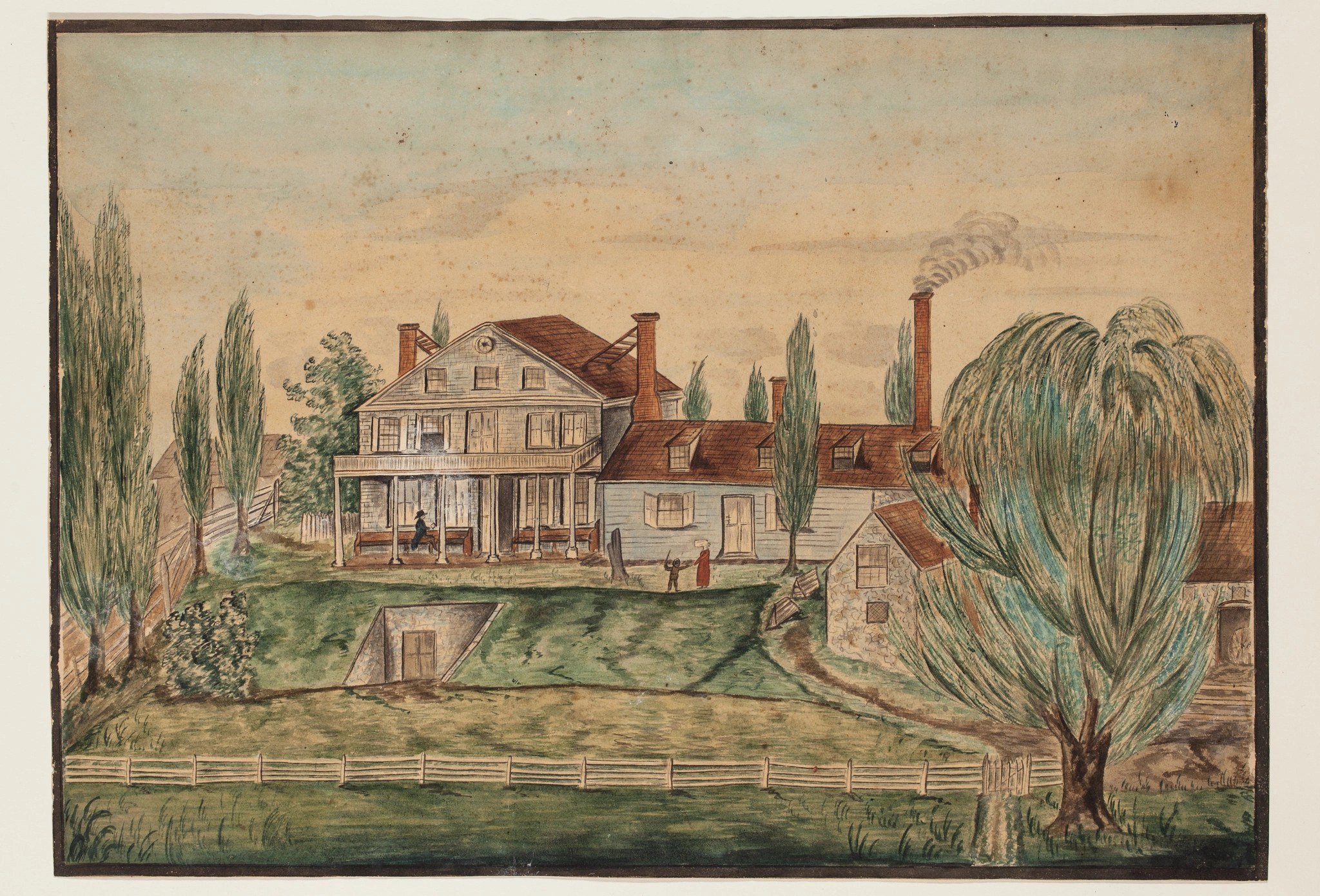
James Coultas built Whitby Hall in 1754 as an English gentleman’s country estate. It was located in Kingsessing (today’s address would be around 58th Street and Florence Avenue in West Philadelphia). By 1922, Kingsessing had become West Philadelphia, and it was no longer rural. It had become a “streetcar suburb,” and rowhouses surrounded the estate. The Grays dismantled the house and relocated it to 131 Tunbridge Road, Haverford.
Watercolor attributed to Martha Coultas Gray Thomas, a daughter of Martha Coultas Ibbetson Gray.
Detroit Institute of Arts, Founders Society Purchase, Gibbs-Williams Fund, 65.29.

Sources for this post include an article entitled “A Heroine of the War for Independence” in a 1913 edition of The Journal of American History by Charles Woodruff Shields (1825–1904). His wife was Elizabeth Kane Shields, who was Martha Ibbetson Gray’s great-granddaughter.
Martha Ibbetson Gray > Elizabeth Gray Leiper > Jane Leiper Kane > Elizabeth Kane Shields
Leave a Reply